
The Caldwell Data Center Action Team is a non-partisan, grassroots organization dedicated to protecting Caldwell County from the rapid expansion of data centers.
Our mission is to analyze the potential impacts, and to educate and organize the community to fight back against the data center takeover. We are pushing for total transparency and maximum community protection from our local city and county governments, and we also recognize that current Texas law limits local regulatory power.
We urgently need updated legislation to protect our communities from rising utility rates, environmental and public health risks, and the massive strain these facilities place on our land and natural resources.
Stay in Touch
Sign Up for our email updates to get involved and receive important announcements about CDCAT meetings, updates, and action opportunities.
Email: info@caldwelldcat.org
Upcoming Events
-
Caldwell DCAT Bi-weekly Meeting
Want to get involved! Join us!
Next meeting:
Dr. Eugene Clark Library
217 S Main St, Lockhart, TX 78644
Tuesday, October 13th 6pm to 7:30pm
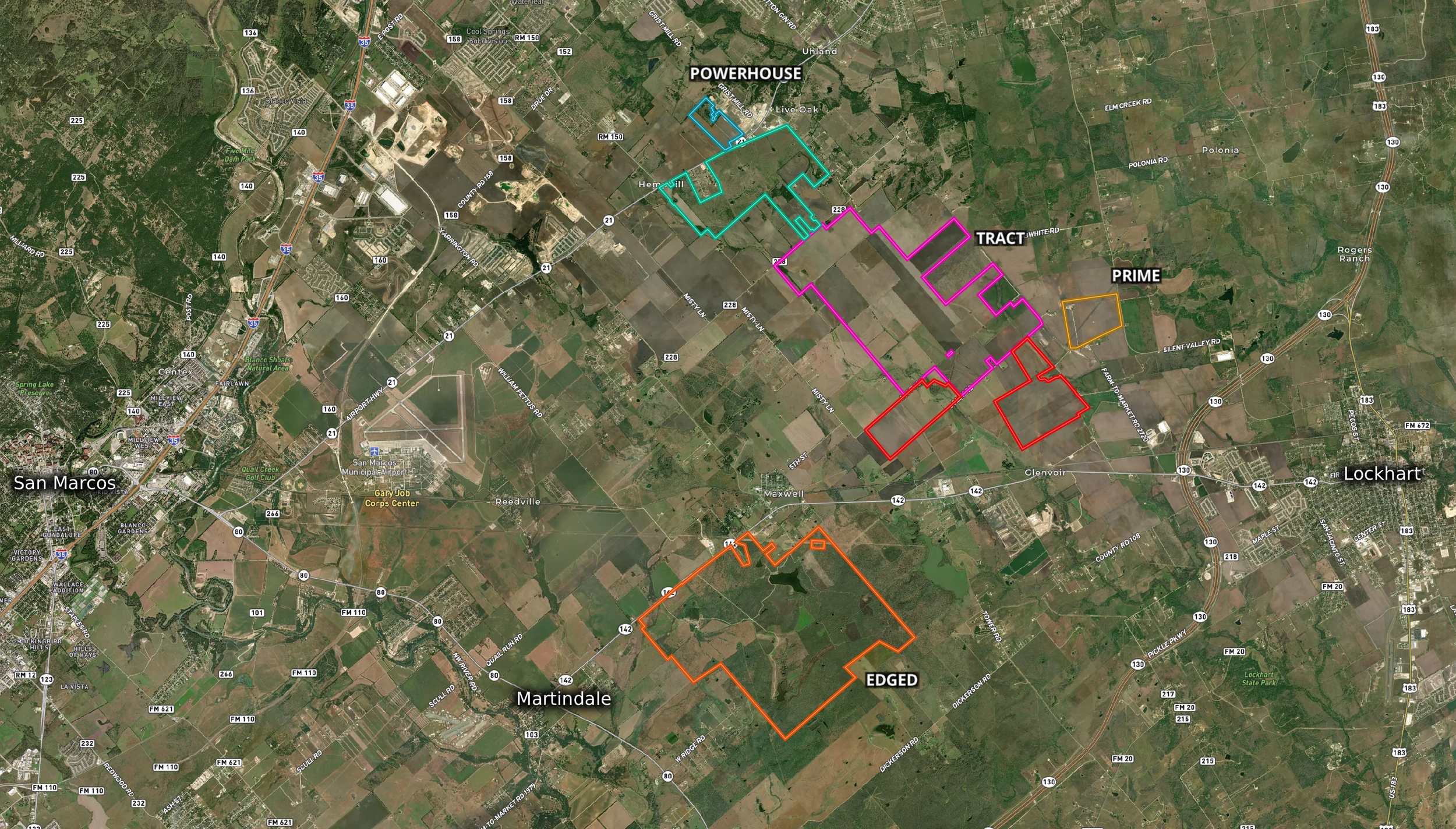
CALDWELL COUNTY
DATA CENTER FACTS
Disclaimer: We are a group of VOLUNTEERS, so if you find any incorrect details below, please let us know! And don’t hesitate to reach out if you can help us fill in the blanks on any unknown items! Thank you.
Prime
Construction Broke Ground June 2026
10-Year, 100% Tax Abatement with PILOT: The county granted a 10-year, 100% property tax abatement on real property improvements. In exchange, Prime Data Centers agreed to make a Payment In-Lieu of Taxes (PILOT) to the county.
Effective PILOT Rate: The annual PILOT payments are calculated at approximately 40% of the standard county property tax levy.
Phase 1 of the development, known as Project Snow, will have a developer capital expenditure of $1.3 billion for 3 buildings. There will be a total of nine data centers on the site when all three phases are completed. The total capital expenditure at full buildout would be $4.2 billion.
$1.3b at property tax rate of $0.4391 per $100 = $5,708,300 / year - 40% PILOT = $3,424,980 / year lost
$4.2b at property tax rate of $0.4391 per $100 = $18,442,200 / year - 40% PILOT = $11,065,320 / year lost
🏷️ ”Project Snow”
💼 Prime data centers LLC (Dallas-based)
👤 Architect - Gensler
⚡ 384 MW
🔌 Powered by the grid (conflicting reports of on-site power)
Bluebonnet Electric Co-op
🗓️ Estimated September 2027 Completion
📍 206 acres at the southeast corner of Farm-to-Market Road 2720 and Bob White Road.
💧 Water Provider: County Line Special Utility District
📝 County Judge Hoppy Haden promoting Prime Data Center: “We are excited to have this project in Caldwell County. It brings a significant capital investment to our county without putting a significant strain on our resources both natural and our personnel.”
Tract
Site prep reportedly underway as of January 2026, with construction predicted to begin in 2027
💵 No Tax Abatements Negotiated Yet (Development Agreement Here)
💼 Developer - Fleet DC (created by Tract Capital)
👤 ?
⚡ Approx 4 GW (huge!!)
🔌 Onsite gas plant + grid connection
🗓️ Projects phased construction through 2032. First 1GW planned to connect in early 2028.
📍 FM 2720, across from Prime - 2,973 acres
💧 Water Provider: County Line Special Utility District
📝 Even in early construction, can still be slowed via TCEQ Contested Case Hearing and/or interference in water connection - what is the water provider??
📝 County Judge Hoppy Haden promoting Tract in media: “partnership based on trust, respect and shared goals.”
Edged Energy
Construction Set to Start June 2026
Chapter 312 Agreement gives Edged exemption on all property value improvements for 10 years. $7.3b improvements at property tax rate of $0.4391 per $100 = $32M/year
PILOT Payment is 50% of property tax bill, so $16,027,150 / year lost
📝 Slated to begin construction in June 2026
💵 $7.3 billion
💼 Edged Energy, subsidiary of Connecticut-based Endeavor, EDC Austin LLC
👤 Bill Greenwood - developer's representative
Contractors:
Architect: Virginia-based MG2 Architecture Corp.
Jordan Schaefer, civil engineer with Kimley-Horn and Associate
⚡ Unknown wattage!
🔌 Eventual grid connection
Stated plan is to use fuel cells then connect to the grid in about 7 years
LCRA/Bluebonnet Electric Co-op
☣️ “Private sewer system” (?)
🗓️ Speculative June 2028 completion
📍 2 million sq ft
11255 Hwy 142
Land owner listed: Capital Land Investments
320 acres out of 2,718 acre parcel (expanded development expected)
📝 Caldwell County development draft agreements oddly states a County demand that the project is started & completed quickly, by a certain timeline, or else development agreement is void. County originally demanded the project start by April 15th. Current status of this timeline-based agreement unclear.
Powerhouse
Not Confirmed
📝 Big community pushback in Uhland city council on April 7th, 2026 - developers moved to de-annex into Caldwell County jurisdiction in late April
💵 No current Caldwell County tax abatements / development agreement
💼 Powerhouse Data Centers, owned and operated by American Real Estate Partners (AREP)
👤 Secret single tenant (disclosed as a ‘big name’ - so Google, Meta, etc.)
⚡ 700 MW
🔌 Onsite gas-fired power plant
📍 SW of Old Spanish Trail and FM 2720
499 acres of data center, rest of 817 acres mixed use - adjacent housing and retail (?!)
📝 Did not present a clear plan to Uhland City Council on April 7th as far as size, or proposed usage of water & power
Mustang Ridge
Not Confirmed
📝 Very little known. Not yet reported in the news.
🏷️ “Project Mockingbird”
💼 Cielo Digital Infrastructure
👤 ?
⚡ ?
🔌 ?
🗓️ ?
📍 Unknown. According to cleanview.co, who doesn’t provide their sources, and may not be accurate, Mockingbird is located at - 30.052 -97.677. GIS shows this as 10007 Evelyn Rd, Buda TX. The acreage doesn’t match up - Cielo’s site says “472 Acres | 400 Buildable Acres”. This parcel is slightly larger and owned by Bock Family Ltd. Can’t find any public record linking Bock Family Ltd. to this. Location still unverified
📝 April 9th 2026 Caldwell County Commissioners discussed in privtae closed session
📝 September 15, 2025 - Mustang Ridge City Council mention preliminary, closed discussion w/ Cielo Digital / Project Mockingbird. Notes mentions it is in Caldwell county.
Talking Points.
NO Tax Abatements
Not critical infrastructure
Data centers are a military target
Health effects are serious and lethal
Increase of utility costs
Drought
Transparency
We have to deal with this now!
Tax abatements
Prime and Edged have been given tax abatements worth tens of millions of dollars. Mustang Ridge is in the early stages of negotiation. We don’t know if Caldwell is negotiating new incentives with Tract or Powerhouse.
City and County officials should not encourage data center developers when the people who elect them don’t want these projects in their community.
Tax abatements matter for data center developers’ decisions to proceed. In April, representatives from Cloudburst Data Center admitted to the Guadalupe County Commissioners that their financing is borderline & they may not be able to proceed without tax abatements. Denying tax abatements may be enough in some cases to stop a project or at least get the developer to look elsewhere. On the other hand, giving away tax abatements attracts more data centers to come!
We are being told tax abatements must be conceded in order to win concessions that protect the community. There’s just one problem: the “concessions” won come nowhere close to solving the issues created by Data Centers, and they’re worth nowhere near the cost of the tax giveaways. Closed loop cooling is often presented as the primary example of data center developers’ concessions. But data center lobbyists constantly claim that modern data centers in Texas already use closed loop cooling. It’s the common standard. These are bad deals and bad negotiation.
Caldwell County has consistently repeated a misunderstanding of municipal tax law, claiming that billions in improved property on the tax roll would paradoxically force the county into insolvency. Giving data centers gigantic corporate handouts by asking them to pay a steeply discounted “Payment in Lieu of Taxes” rate is a supposed solution to this problem. This is based on a misunderstanding about the minutiae of state tax law.
.: Others threw cold water on Haden's claim. Despite the law's constraints, the influx of investment should still result in additional revenue outside of those limits based on how the law is structured, one tax expert said. If the tax base grows dramatically, the rate can lower dramatically, but that lower rate applies to a much larger base. Some are calling on the County to be more transparent about those cash-flow projections.
“Texas’s 3.5% voter-approval limit is not a blanket cap on all new revenue, and new property value is treated differently under the no-new-revenue calculation. If the county is claiming that fully taxing new data centers would create a cash-flow crisis, it should show the tax-rate worksheet and a month-by-month cash-flow projection," Anthony Elmo, who works with Washington D.C.-based corporate and government accountability organization Good Jobs First, said in an email.
Caldwell County government has refused to give a simple, dollar figure amount of county revenue that is set to be given away over the projected lifetime. Before any agreement is approved, the county should provide a plain-language “GASB 77-style” disclosure table showing, by project and by year:
Estimated appraised value;
Estimated taxable value without the abatement;
Estimated county taxes that would otherwise be owed;
Percent and dollar amount abated;
PILOT amount expected;
Net fiscal impact to the county;
Required company performance obligations;
Enforcement and clawback provisions.
If the real purpose of tax abatements is to secure environmental, water, road, and operating standards, then the public should be able to evaluate whether giving up 50% of county taxes is the least-cost way to obtain those protections. A clear GASB 77-style accounting would also help residents understand the real cost of the abatement, rather than seeing only the PILOT revenue side of the transaction.
Not Critical Infrastructure
The overwhelming majority of basic internet functionality, including essential services, are supported by existing data center infrastructure.
Developers want regular people to believe their needs will be met by new data centers, but the current boom is fueled by speculative investment in dangerously-underregulated AI technologies being pushed by a handful of billionaires for their questionable objectives.
Behind shell development companies, investment for data centers is typically Meta/Facebook, Microsoft, Oracle, Google, Amazon, or major AI firms
Much of the technology being foisted on us is not desired by communities.
Ex. automated license plate readers, automatic facial detection and other privacy-eroding technologies, automated kill chain targeting
Data Centers are a Military Target
But if it were “critical infrastructure”, a Caldwell County data center cluster as large as the so-called “data center capital of the world” outside of Washington DC could make our area a military target.
As seen during the US War on Iran, data centers have become a major bombing target in international war
Health effects are serious and lethal
The Caldwell County resolution mentions the health effects of data centers, below - how does Caldwell County plan to enforce these concerns without a formal moratorium or other concrete steps?
“[Caldwell County] opposes any data center development that fails to incorporate adequate safeguards to protect county resources and residents.
Counties…bear responsibility for protecting public health, safety, infrastructure integrity, and natural resources within their jurisdiction
[Caldwell County] opposes any data center development that fails to incorporate adequate safeguards to protect county resources and residents.”
More Information on Data Center Health Concerns:
Heat Island
Recent research (University of Cambridge) shows data centers raise surface temperatures by an average of more than 3 degrees; in extreme cases, temperatures were more than 16 degrees higher
Data center heat islands can extend for more than 6 miles from the site
Heat stress is a major cause of death for livestock; increased temperatures would make farming and ranching more challenging in our region.
Air Pollution
Living near a cluster of data centers is even worse for human health than living next to a gas-fired power plant (Virginia Commonwealth University); Caldwell County residents could be getting both.
Increase in smog and heat raises suicide risk (University of Utah)
Multiple data center projects in Caldwell Co. plan to build their own gas plants; Tract’s would generate twice the power of the largest gas plant in Texas.
On-site power plants at Caldwell County data centers would likely result in catastrophic health outcomes for residents.
Analysis of the onsite power generation from a 135 MW data center in Northern Virginia estimates up to $99 million of health damages each year from premature mortality, respiratory and cardiovascular disease.
Diesel generators - the dirtiest form of combustion, meant for actual emergencies
Back-up generators are tested regularly and used when the grid is strained, which could be quite often given that our current grid infrastructure cannot support so many large loads from data centers.
Generators emit fine particulate matter (PM10 and PM2.5), carbon monoxide (CO), nitrogen oxides (NOx), sulfur dioxide (SO2), and volatile organic compounds (VOC).
These pollutants cause asthma, heart attacks, dementia, cancer, lung disease.
Less than 1 GW of diesel generators inflict >%150 million in health costs in the “data center capital of the world” (Piedmont Environmental Council)
Water contamination
Data centers use proprietary cocktails of chemicals to cool servers. Coolant chemicals are kept secret with nondisclosure agreements, however they frequently contain hazardous substances;
water discharged can carry harmful carcinogens (PFAS, glycol, and heavy metals).
PFAS are persistent, bioaccumulating poisons which are not removed by wastewater treatment..
Noise
Data centers produce constant noise, which can reach 80-90 decibels
Persistent noise, even frequencies imperceptible to human hearing, can damage health; children and elderly are even more vulnerable
Chronic exposure to noise can cause or exacerbate cardiovascular disease; type 2 diabetes; sleep disturbances; stress; mental health and cognition problems, including memory impairment and attention deficits; childhood learning delays; and low birth weight.
Livestock and other creatures are also sensitive to noise pollution.
Increase of utility costs
Power bills near data centers go way up. A 2025 Bloomberg study showed that in areas with significant data center development, wholesale electricity costs rose by up to 267%!
New York City uses 5.5 GW of power on average. If all five projects are constructed, the data centers in Caldwell County would use more electricity than the most populated city in the United States!
TX grid capacity would need to more than double in the next few years to accommodate data centers. Due to large loads, ERCOT has proposed a new 765-kV transmission plan that will cost Texas just over $32 Billion; this cost would be passed off to ratepayers.
Drought
Closed-loop cooling isn’t the issue: most water consumption in data centers is from power generation.
How much water are these massive power plants going to use? HARC (Houston Advanced Research Center) estimates 207 gal/MWh, which would amount to about 5 million gallons each day for a 1 GW data center.
Some data center developers claim water consumption is a “security” secret and will not disclose their onsite use.
New research from the University of Texas estimates data centers could use up to 9% of Texas’ water by 2040.
Most of Texas’ river flow is effluent during much of the year. Calling it ‘wastewater’ or ‘reclaimed’ confuses the issue - overdrawing and misusing will dry up local water either way. Suggesting data centers use this water for their operations is not a solution.
Transparency
City and County governments are often the first to hear about development projects, and need to share what they learn with their community. Why have most of us not heard about Mustang Ridge from the County Commissioners, when they are already in negotiations with them?
People deserve to not be scrambling and overwhelmed. We need our elected officials to share information with the public proactively.
We have to deal with this now, not hope we can solve it next year through the legislature
Every elected official in Caldwell County should be publicly demanding the Texas Legislature to call for a Special Session to provide regulatory relief for local governments.
At the same time, it is simply not true that the only way to address things is through state-level policy. Everyone knows the State has primary regulatory power – and that they are unlikely to do anything serious about data center development, especially anytime soon. Many counties around Texas, including Hill and Hays Counties, are getting creative to test the boundaries of what can be done to protect our communities. We need to make things happen here, now – not far away, at some point in the future.
Contact Your Elected Officials
Federal
US Senator John Cornyn
(202) 224-2934
US Senator Ted Cruz
(202) 224-5922
Congressman Michael Cloud
(202) 225-7742
Governor Greg Abbott
(512) 463-2000
State Senator Judith Zaffirini
judith.zaffirini@senate.texas.gov
(512) 463-0121
State Representative Stan Gerdes
(512) 463-0682
Caldwell County
County Judge Hoppy Haden
Pct. 1 Commissioner BJ Westmoreland
bj.westmoreland@co.caldwell.tx.us
Pct. 2 Commissioner Rusty Horne
Pct. 3 Commissioner Ed Theriot
Pct. 4 Commissioner Dyral Thomas
dyral.thomas@co.caldwell.tx.us
Power & Water Authorities
Lower Colorado River Authority (LCRA)
(512) 473-3200
Plum Creek Conservation District (PCCD)
(512) 398-2383
Gonzales Underground Water Conservation District (GCUWCD)
(830) 672-1047
Barton Springs Edwards Aquifer Conservation District (BSEACD)
(512) 282-8441
SAMPLE OUTREACH TEMPLATE
Dear [Name & Title],
I am writing as a concerned resident of [City] located in Caldwell County regarding the rapid expansion of large-scale data centers across Texas and the significant impacts these facilities may have on our communities.
While Texas welcomes responsible economic development, the pace at which data center projects are being proposed and constructed is raising serious concerns about water availability, electrical grid demand, wastewater disposal, and long-term environmental accountability, particularly in rural and fast-growing areas like ours.
In Caldwell County, residents have received limited information regarding the scale of water consumption, the use of deep-well injection for wastewater disposal, and the long-term environmental safeguards associated with these facilities. These unanswered questions create significant concern for families who rely on local groundwater and infrastructure.
Many families here have already experienced dramatic increases in utility costs. Residents are understandably concerned that large-scale industrial data centers could place additional strain on local water supplies and the electric grid while providing limited benefit to the surrounding community.
For these reasons, I respectfully urge you to take proactive steps to protect communities and infrastructure by:
Publicly call for the Texas Legislature to schedule a Special Session to provide local governments with regulatory relief
Pass a moratorium on data centers
Stop giving data centers tax abatements
Conduct a comprehensive review of water usage and wastewater disposal practices associated with large data centers
Evaluate the impact of high-energy-demand facilities on our electrical grid and local electric cooperatives
Establish clear environmental accountability and long-term liability standards for wastewater disposal and other industrial byproducts
Ensure greater transparency and local input when large-scale data centers are proposed
Given the rapid pace of development, I also encourage the Texas Legislature to consider a moratorium on new large-scale data center approvals until these issues can be fully evaluated and appropriate safeguards are in place. Texas communities should not be placed in a position where essential resources such as water, energy, and environmental stability are at risk without clear oversight and protections.
Thank you for your service to the people of Texas and for your consideration of this important issue affecting our community.
Respectfully,
[Your Name]